

The Mornings We Get
Before the Day Begins :: The Sacred Morning Ritual You Share With Your Dog
There is a small window of time each morning when the world has not quite started yet. Before the tasks, the news, coffee, work, appointments and responsibilities. Sometimes even before our feet touch the floor. For many of us who share our lives (and sometimes our beds) with dogs, there is someone else there. A warm body curled against our legs, a sleepy face looking back at us, a paw stretched across the blankets, or a tail beginning to thump the moment our eyes open.
I've thought about this particular time of day for years, in part because of something I experienced during my Animal Chaplain training a few years ago. The subject of morning rituals with our animals came up among our group of nearly 75 students, and almost everyone had something to say. People shared stories about the particular ways their animals greeted them, the routines they had developed together, the quiet moments they protected, and the small exchanges that would have looked completely ordinary from the outside but carried tremendous meaning within their relationship.
I remember being struck by how universal it seemed. We were different people from different backgrounds, with different animals, beliefs and lives, and yet so many of us intuitively understood that there was something special about those first moments of the day. It stayed with me, and over the years I've come to wonder if this little window of time may be more meaningful - and even more beneficial - than we realize.
Why the First Moments Matter
Across spiritual and contemplative traditions, the beginning of the day has long been treated as important territory. We are encouraged to meditate before the mind becomes busy, to pray, offer gratitude, set an intention, or simply take a few conscious breaths before reaching for our phones and allowing the outside world to tell us what deserves our attention.
Zen Buddhist teacher Thich Nhat Hanh taught a simple morning gatha, or short verse used as a mindfulness practice, that begins, “Waking up this morning, I smile.” His teachings remind us that mindfulness doesn't have to be reserved for the meditation cushion. Brushing our teeth, preparing breakfast, walking the dog and washing dishes can all become spiritual practices when we bring our full awareness to them.
The same can be true of our morning time with our dogs. Perhaps these few quiet minutes aren't something that happens before our mindfulness or spiritual practice. When we are truly present for them, perhaps they already are one.
Consider the difference between beginning your day with your dog and beginning it with your phone. Within seconds of picking up a device, our minds can be filled with headlines, emails, notifications, work demands, other people's lives and problems that weren't even in our awareness moments earlier. Our attention has essentially left the room before our body has left the bed.
When the first thing we intentionally attend to is a living being we love, something very different happens. We feel the warmth of their body, notice their breathing, meet their eyes or feel their touch. Instead of beginning the day by consuming information, we begin it in relationship and connection. And it turns out there is some fascinating biology happening underneath something that feels so simple.
The Biology of Connection
Researchers studying the human-dog bond have found measurable physiological changes during positive interactions between dogs and their people. One of the most fascinating involves oxytocin, a neuropeptide deeply involved in social bonding and attachment.
In a landmark 2015 study published in Science, researchers found evidence of what they called an oxytocin-gaze positive loop between humans and dogs. When dogs gazed at their humans, oxytocin increased in the humans; this was associated with more interaction between them, which was then associated with increased oxytocin in the dogs. Earlier research examining positive human-dog interaction also found increases in neurochemicals connected with bonding and positive emotional states (including oxytocin and dopamine) in both species.
This doesn't mean we need to turn our morning cuddle into another wellness protocol, measuring how many minutes of eye contact are required to optimize our hormones. That would miss the point entirely. What the research offers instead is evidence that what we experience emotionally with our dogs is also happening physiologically. Our bodies are participating in the relationship, too.
There is even interesting research suggesting that positive experiences in the morning may influence how the body moves through the rest of the day. A study of more than 1,600 adults found that positive events occurring in the morning were associated with a steeper decline in cortisol throughout that same day, a pattern generally associated with healthier regulation of the stress-response system.
Are You With Your Dog, or Simply Beside Them?
Canine cognition researcher and author Alexandra Horowitz has spent years studying how dogs experience their world, and much of her work challenges us to recognize how frequently we look at dogs without actually seeing them. Speaking about what dogs can teach humans about attention, Horowitz said something wonderfully simple: “There is a ton of pleasure for me in noticing.”
I think there is an important distinction here for those of us who live very closely with our dogs. We can wake beside our dog every morning and still miss the experience. We can stroke their fur while reading an email, kiss their head while mentally rehearsing our schedule, or share a bed with them for ten years and become so accustomed to their presence that we no longer truly notice the being lying beside us.
So rather than simply greeting your dog tomorrow morning, spend a little time observing them. How are they holding their body? What happens when your eyes meet? Do they move toward you or prefer a little space? Do they stretch, sigh, roll onto their back, bring you a toy, or immediately begin lobbying for breakfast? Who is your dog this morning?
There is something practical about this kind of attention, too. When we genuinely observe our dogs each morning, we develop an intimate understanding of what is normal for them - the way they rise and stretch, their posture and gait, breathing, eyes, appetite, energy and willingness to engage.
For those of us living with aging dogs especially, these tiny observations can become a valuable informal wellness check. We may notice a hesitation getting up that wasn't there yesterday, a slightly different posture, less interest in breakfast, an unusual need for closeness or perhaps an unusual desire to be left alone. Presence isn't only a spiritual practice; it can also make us more observant guardians.
Let Your Dog Show You the Ritual
Not every dog is a morning cuddler, of course. Some climb onto our chests the moment we stir, while others sleep at the foot of the bed or in another room entirely. One dog may greet the morning by rolling over for a belly rub, while another presents a tennis ball and is ready to get moving. And some would simply like us to stop contemplating the sacredness of the moment and open the back door.
The invitation isn't to manufacture a ritual or insist upon affection our dog doesn't want. It's to become curious about the ritual that may already exist between you. What does your dog naturally offer in those first moments of the day, and what changes when you become fully available to receive it?
This is one of the things Animal Chaplaincy has taught me most deeply: sacred moments rarely announce themselves as sacred while they are happening. Most look remarkably ordinary. The familiar sound of paws following us through the house, the head resting on our knee, the dog waiting outside the bathroom door, the warm body that takes up far more than its fair share of the bed - these experiences repeat so often that our minds begin to label them as normal. And what becomes normal is very easy to stop seeing.
Buddhist teacher Pema Chödrön has spoken about the “fleeting golden moments” in our lives that we so often speed right past. I can't think of a better description of so many of the moments we share with our dogs.
The Mornings We Get
Anyone who has loved and lost an animal understands this in a particularly profound way: we have a finite number of mornings with our dogs. We don't know how many, and we don't need to count them, but there will eventually come a time when the things we once barely noticed are among the things we would most love to experience again - the sleepy face beside us, the weight against our legs, the familiar morning stretch, the sound of paws following us out of the bedroom.
This isn't an invitation to make ourselves sad while our dogs are here. Quite the opposite. It's an invitation to recognize these mornings while we still have them. There is something about impermanence that brings the ordinary into sharper focus, reminding us that the experiences we assume will happen again tomorrow are worthy of our attention today.
And perhaps that's part of why those nearly 75 Animal Chaplain students had so much to say about their mornings! Somewhere within us, I think we understand that these seemingly insignificant rituals are part of the fabric of a life shared with another being. We don't usually recognize them as milestones because they aren't. They are something quieter and, in many ways, more important - they are the life itself.
Tomorrow Morning
You don't need another complicated morning routine. There is nothing to purchase, track or perfect. Tomorrow, simply consider giving your dog the first three undistracted minutes of your day before allowing the outside world into your mind.
Notice your dog. If they enjoy touch, feel the warmth of their body beneath your hand. If they offer their gaze, meet it. Notice their breathing and then notice your own. Observe how they are moving and how they seem to be feeling without immediately interpreting or trying to change anything. You might even offer a simple intention, silently or aloud: Thank you for being here. May you be well today. May we meet this day together.
Three minutes isn't going to magically transform your life, nor is this about turning one more part of our relationship with our dogs into something we need to do correctly. It's simply a way of reclaiming our attention at a time when almost everything in the modern world is competing to take it from us.
Before we meditate, pray, write down what we're grateful for or decide what kind of day we're going to have, there may already be a living, breathing invitation beside us to become present, to notice and to connect.
Perhaps the practice isn't learning how to create a sacred morning ritual with our dogs after all. Perhaps it's recognizing the one that has quietly been happening all along, and being fully here for the mornings we get.

By Amanda Ree, Founder of Sama Dog
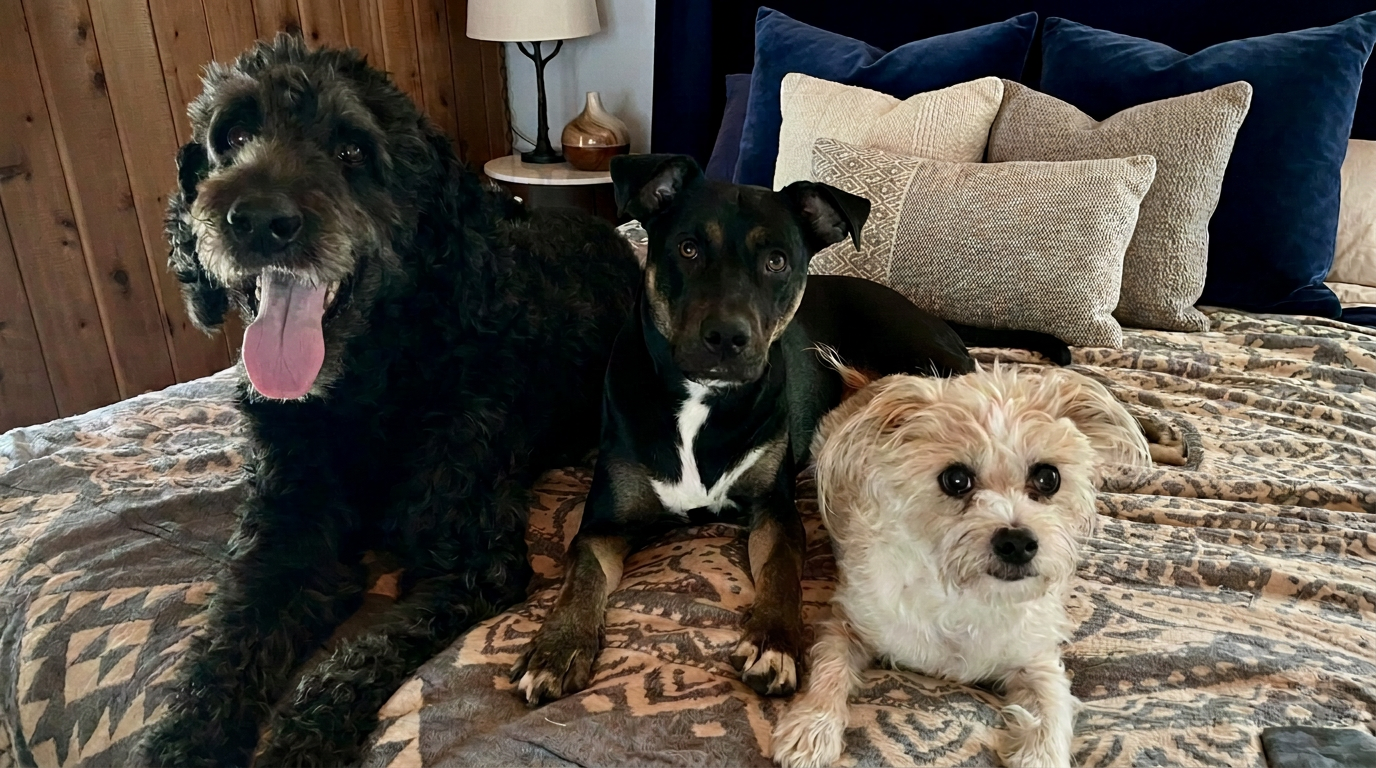
Photo: Violet, Poppy & Benny, Amanda’s canine companions (from left to right)
If this message resonated with you, we invite you to explore more, like our unique membership group dedicated to natural wellbeing for dogs and their humans, called Sama Circle.
References & Further Exploration
Nagasawa M, et al. Oxytocin-gaze positive loop and the coevolution of human-dog bonds.Science, 2015.
Odendaal JSJ, Meintjes RA. Neurophysiological Correlates of Affiliative Behaviour between Humans and Dogs.The Veterinary Journal, 2003.
Sin NL, et al. Daily positive events and diurnal cortisol rhythms: Examination of between-person differences and within-person variation. Psychoneuroendocrinology, 2017.
Alexandra Horowitz - canine cognition researcher and author of Inside of a Dog and Being a Dog.
Thich Nhat Hanh / Plum Village - teachings on morning gathas and mindfulness in everyday life.
Pema Chödrön - Buddhist teacher and author whose work explores presence, impermanence and the “fleeting golden moments” of everyday life.